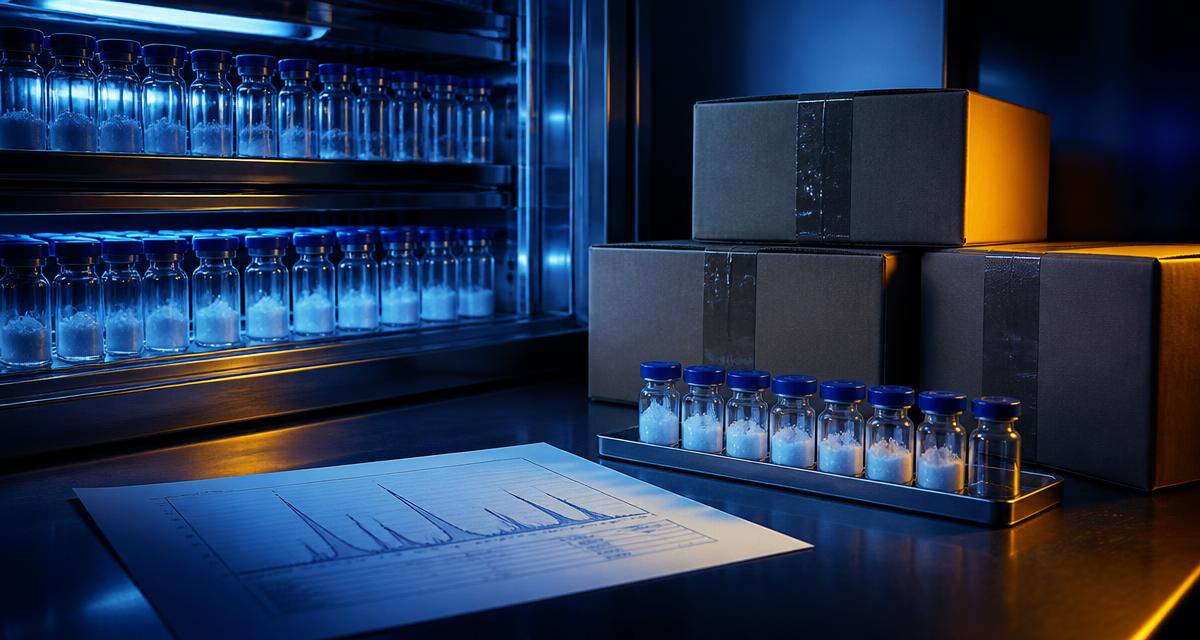
Short answer: In 2026 there are three realistic ways to stock a research peptide store: buy wholesale and hold inventory, white-label a manufacturer's product under your own brand, or dropship through a fulfilment partner. Almost all of the underlying synthesis happens in China or India whatever the vendor's flag says, so the supplier's job is really testing and chain of custody, not making the peptide. Judge suppliers on batch-specific third-party COAs (HPLC purity plus mass spec identity plus endotoxin), not on price or a US or UK address. And plan your payments before you order stock, because a store that can't take cards is a warehouse, not a business. If that last part is where you are, tell us about your business and we'll come back within one working day.
I source for my own research peptide store and I place peptide merchants with acquiring banks through UniqPay, so this is written from both ends of the transaction.
The three sourcing models, honestly compared
Wholesale (hold your own stock). You buy vials in bulk, typically 20 to 100 vial minimums for mix-and-match tiers, at a fraction of retail, and fulfil yourself or via a 3PL. Best margins, full control over labelling and testing, and the only model where you can independently re-test what you sell. Downside: capital tied up in stock, cold-chain storage (lyophilised at minus 20°C is the only format where shelf-life claims are credible), and you carry the compliance risk of your own labels.
White label / private label. The supplier manufactures, tests and ships vials under your brand, often with a setup fee and a per-vial premium over plain wholesale. Faster to launch, and good suppliers will put your logo, lot number, purity and research-use statement on the label. You still own the brand presentation and therefore the regulatory exposure. Check whether the COA is issued in your name or theirs.
Dropshipping. Zero inventory, the supplier ships direct to your customer. Lowest barrier to entry and, in this category, the weakest position. You never see the product, you can't verify what left the warehouse, and if the supplier's batch fails or their labels make claims yours don't, it's your store name on the parcel and your merchant account taking the disputes. Some dropship platforms advertise "500+ retailers" and screenshots of five-figure months; treat those as marketing, not evidence.
For most serious operators the answer in 2026 is wholesale or white label with a small starter order, independent testing, then scaling with a second supplier as backup.
Where peptides actually come from
Research peptide synthesis is heavily concentrated in China and India regardless of where the vendor is incorporated. A US or UK company is usually importing bulk API and either re-testing and vialing domestically or simply relabelling. That isn't a red flag by itself, but it means the question to ask a supplier is not "where are you based" but "who synthesises, who tests, and can I see the chromatogram for this lot".
Sourcing directly from Chinese manufacturers is possible and can be dramatically cheaper, but Alibaba has been quietly de-listing GLP-1 search terms since the 2023 crackdown by the Chinese regulator, so most direct sourcing now happens through Made-in-China, direct factory contacts or agents. If you go that route: ask for a live video tour of the facility (clean rooms, synthesisers, HPLC and MS on site), buy the smallest quantity first, send it to an accredited independent lab, and only scale if the results land within a point or two of the supplier's COA. Budget for the testing. It is the cheapest insurance you'll ever buy.
How to read a COA (and spot a fake one)
The single most useful supplier signal is a batch-specific certificate of analysis from a named, independent lab. Most vendor COAs fail at least one of these:
- HPLC purity, with the actual chromatogram, not just a number. Look for one dominant peak and method details (column, mobile phase, wavelength). Purity claims that read exactly 99.0% batch after batch are a warning sign.
- Mass spectrometry identity. HPLC tells you how pure something is; MS tells you what it is. GLP-1 analogues are the most commonly mislabelled compounds in 2025–26 independent testing because a truncated fragment can pass an HPLC purity curve while having the wrong molecular weight. In one 2026 blind test a bottom-tier vendor's "semaglutide" came back at 2,847 Da instead of the expected 4,113 Da. It wasn't semaglutide.
- Endotoxin (LAL) results. Relevant for any lab use and a basic hygiene marker for the manufacturer.
- Lot number that matches the vial in your hand, a test date after the manufacture date, and a lab you can look up independently.
Other red flags: in-house testing only, purity below 98% without explanation, no stated storage or shipping conditions, pre-mixed solutions arriving by post, no physical address, and pricing far below the market. Cheap peptides are usually cheap for a reason.
UK-specific: import, MHRA and how you present the product
Research peptides that aren't controlled under the Misuse of Drugs Act can be lawfully bought, imported and sold in the UK as research reagents. Imports for genuine research, particularly by registered businesses, generally clear customs without issue. What changes the legal status is presentation, not chemistry. The moment your site or labels imply human use (dosing, reconstitution guides, injection advice, before-and-after imagery, testimonials about effects, therapeutic or performance claims) the product becomes an unlicensed medicine under the Human Medicines Regulations 2012, and a research-use footer does not rescue a page that otherwise reads as instructions.
That matters more in 2026 than it did. The MHRA has been reported to have opened investigations into UK clinics and retailers making therapeutic claims about unregulated peptides in spring 2026. Semaglutide, tirzepatide and retatrutide are a separate case again: in the UK those are prescription-only medicines and can only be supplied by a GPhC-registered pharmacy against a prescription. Research-grade versions sold as reagents are not those medicines and cannot be marketed as if they were.
Practically, this means your supplier's labels have to match your positioning. A white-label partner who prints "GLP-1 weight-loss" on the vial has just handed you a compliance problem and, as I'll come to, a banking one.
Pricing and terms to expect
Wholesale tiers are usually set per peptide, per order, with mix-and-match qualifying at the highest tier reached. Minimums range from around 20 vials at the low end to 100-vial mix-and-match minimums at some US wholesalers, with volume breaks running up into the thousands. Some suppliers charge extra for the per-lot COA. Setup fees for custom labels are normal; ongoing per-vial premiums for white label of 15–40% over plain wholesale are typical. Payment terms from suppliers are almost always upfront by wire or crypto for a new account, which is another reason not to over-order before you've tested.
The part nobody tells you: getting paid
Here's the pattern I see constantly. Someone spends two months vetting suppliers, spends £5–15k on a first order, builds a clean site, opens Shopify or WooCommerce with Stripe, and starts selling. Six weeks later the payment account is permanently limited, the last month's takings are frozen for 90 to 180 days, and the stock is sitting there depreciating.
Stripe, Shopify Payments, PayPal, Square and SumUp all prohibit research chemicals and unapproved pharmaceuticals, whatever your disclaimers say. In 2026 Mastercard's BRAM programme has tightened specifically around research peptides, and processors that used to look the other way have exited the category. The right sequence is to get underwritten by an acquirer that knowingly accepts peptide catalogues before or while you place your first stock order, so the site language, labels and policies are built to pass underwriting from day one rather than retrofitted after a shutdown.
That's what UniqPay does. We're an introducer, not a single processor, so we place research peptide and GLP-1 merchants across several UK, EU, US and offshore acquirers depending on catalogue and jurisdiction, and we tell you up front which supplier label wording or product-page claims will get you declined. Typical placements run 3.5–5.5% with a 5–10% rolling reserve, approvals in 3–7 working days for a prepared file, and we'll usually recommend a second rail (open banking Pay by Bank in the UK, ACH in the US, or card-to-crypto settlement) so one bank's portfolio review can't take you offline.
If you want the full detail on the payments side, read Peptide Payment Processing in 2026.
What happens when you get in touch
Fill in the form below and you'll hear from me directly. I'll ask where you're incorporated, what you plan to sell and to whom, your supplier and labelling setup, expected monthly volume, and whether you've been terminated anywhere before. Within one working day you'll get an honest read on which acquirers fit, what the rate and reserve will roughly look like, and what to fix on the site before applying. If you're still at the sourcing stage, that's the ideal time to talk, because we can help you build the store to pass underwriting rather than fail it.
No fee to talk, no fee to apply. We're paid by the acquirer when you're live.
Get a peptide merchant account quote →
FAQ
Is dropshipping peptides legal?
The same rules apply as any peptide sale: research-use-only presentation, no human-use claims, and in the UK nothing that would make the product an unlicensed medicine. The bigger issue with dropshipping isn't legality, it's that you can't verify what ships and you carry the disputes.
Can I import peptides into the UK to resell?
Research reagents imported by a registered business for genuine research supply generally clear customs. Anything presented for human use, and GLP-1 medicines in particular, is a different matter and can be seized.
Do I need LegitScript to source or sell research peptides?
Not for sourcing, and not for a research-use-only catalogue with most domestic acquirers. GLP-1 prescription and telehealth models are different and usually do need it.
Which peptides do wholesalers most commonly stock in 2026?
BPC-157, TB-500, GHK-Cu, CJC-1295, ipamorelin, PT-141, epithalon, semaglutide and tirzepatide analogues, and increasingly retatrutide. Availability shifts as regulatory guidance changes.
How much should I spend on independent testing?
Enough to test at least one lot from every supplier before you scale, and periodically after. A single failed batch costs you far more in refunds, chargebacks and reputation than a year of lab fees.