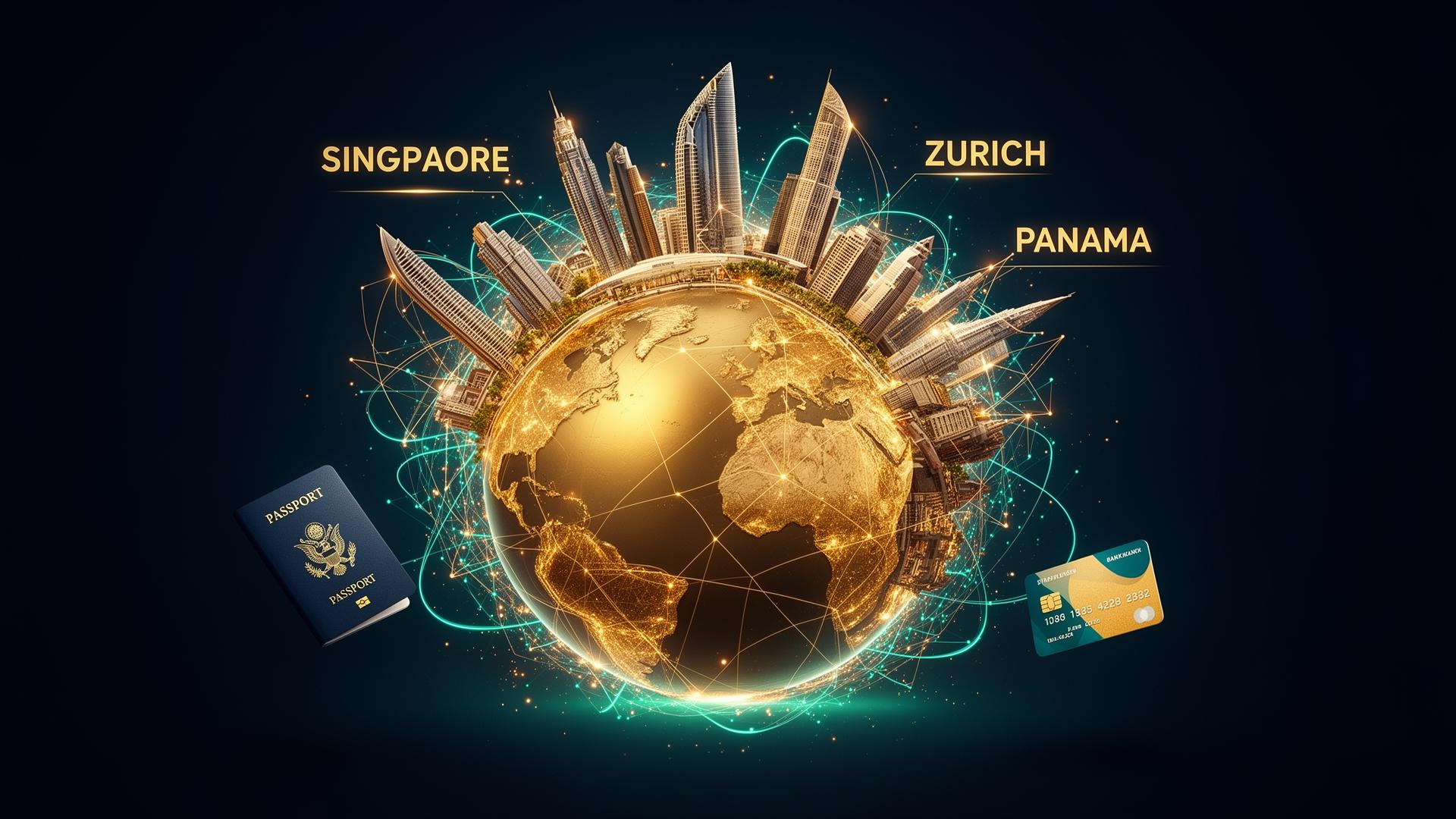
The window for friction-free offshore banking is closing. Between new OECD reporting requirements, the tightening of Know Your Customer (KYC) protocols, and the global crackdown on anonymous shell structures, the "golden era" of instant offshore access is fading.
If you have been sitting on the fence—scared off by Hollywood depictions of numbered accounts in the Alps, or confused by the jargon—now is the time to move.
Offshore banking is no longer a luxury reserved for billionaires fleeing taxes. It is a logical risk management tool for any entrepreneur, freelancer, or digital nomad who refuses to keep all their eggs in one collapsing basket.
Here is exactly how to get in, where to go, and the silent pitfalls most first-timers miss.
What "Offshore" Actually Means in 2025
Let's kill the confusion immediately. Offshore does not automatically mean a tiny island with palm trees and zero taxes. Linguistically, it simply means banking outside your country of residence.
- A German citizen banking in Switzerland? Offshore.
- An American business opening a GBP account in London? Offshore.
- A remote worker in Bali using a Singaporean fintech? Offshore.
The concept is simple. The execution, however, requires strategy. Regulations vary wildly between jurisdictions, and what works for a crypto trader in Dubai will fail for a consultant in Canada.
The 5 Real Benefits (Beyond Just "Tax Stuff")
Media tends to frame offshore banking as a loophole. In reality, most users open foreign accounts for reasons far more boring—and far more practical.
1. Sovereignty & Currency Diversification
If your local currency is depreciating (looking at you, rampant inflation), holding funds in USD, CHF, or SGD acts as a shield. You aren't betting against your country; you are simply refusing to let political instability wipe out your purchasing power.
2. Operational Convenience
Do you pay suppliers in China, customers in Europe, and rent in Bali? A single multi-currency offshore account allows you to hold, spend, and convert without losing 3–5% in hidden SWIFT fees every time money moves.
3. Asset Protection via Geography
If you operate in a litigious industry or a region with shaky legal systems, keeping capital offshore ensures that a frivolous local lawsuit cannot freeze your operating cash. It's not evasion; it's separation.
4. Privacy (Not Secrecy)
Let's be clear: Anonymous accounts are extinct. However, jurisdictions like Singapore and Switzerland still offer discretion. Your banking affairs are not public record, and they are not sold to marketing aggregators. That is the modern definition of privacy.
5. Investment Optionality
Some countries simply have better financial products. If you want exposure to emerging markets, private equity, or commodities that your local high street bank doesn't offer, you follow the opportunity.
The Step-by-Step Playbook: Opening Your Account
Forget the mystery. Opening an account is a checklist, not a magic trick.
Step 1: Strategic Alignment
Do not open an account because "Switzerland sounds nice." Open it because you need EUR capacity, or because you need a jurisdiction with robust asset protection laws. Start with the "Why."
Step 2: The Document Trinity
Banks are terrified of money laundering fines. To get approved, you must prove you are boring and legitimate.
- Proof of Identity: Passport (scans of all pages, no cropping).
- Proof of Address: Utility bill or bank statement dated within the last 3 months.
- Source of Funds: The killer requirement. Be prepared to show salary slips, corporate tax returns, or sale & purchase agreements. "I saved it" is rarely enough anymore.
Step 3: The KYC Ritual
Depending on the bank, you will either upload documents and wait (2–10 days), or engage in a live video call where you hold your passport next to your face and perform "liveness" checks (turn left, smile, show the ceiling).
Pro Tip
Do not wear sunglasses. Do not sit in a dark room. Banks flag low-light video as high-risk.
Step 4: Funding
Once approved, you must "activate" the account. Some banks require a minimum deposit ($1,000 – $100,000+) to keep the account out of dormancy.
The Shortlist: Where to Open Right Now
Switzerland
Best for: Privacy hawks, long-term wealth preservation.
Reality: Expensive. You will pay for the prestige. Minimum deposits are rising.
Singapore
Best for: Business owners, Asia exposure, multi-currency needs.
Reality: Strict compliance, but fast digital onboarding for qualifying individuals.
Cayman Islands
Best for: Institutional investors, hedge funds.
Reality: Generally not for the casual retail client seeking a debit card.
UAE (Dubai)
Best for: Crypto entrepreneurs, tax residency seekers.
Reality: Booming, but banks are increasingly picky about source of wealth.
Panama
Best for: Latin American exposure, competitive corporate rates.
Reality: Reputation varies; due diligence on the specific bank is non-negotiable.
Mauritius
Best for: African trade, India-facing structures.
Reality: Stable, well-regulated, but niche.
The "Hidden" Risks of Banking Abroad
Offshore banking is not a set-it-and-forget-it game. If you ignore these three realities, you will regret the move.
1. The "Correspondent" Bottleneck
Your offshore bank likely relies on a larger Western bank (JPMorgan, Citibank) to move USD or EUR. If that correspondent bank severs ties due to geopolitical pressure, your money is trapped in that jurisdiction until you physically retrieve it.
2. Deposit Protection Gaps
In the EU, your money is guaranteed up to €100,000. In the Cayman Islands? There is no government-backed deposit insurance for non-bankrupt entities. If the bank fails, you are an unsecured creditor.
3. The "Unexpected Branch Visit"
Some jurisdictions are digitizing. Some are not. Do not assume you can open an account in Jersey while sitting in Texas. Read the fine print: Is video KYC accepted, or is a physical visit mandatory?
Should You Go It Alone or Hire Help?
The rule of thumb:
- Checking account with a debit card: Do it yourself. Use the bank's website.
- Corporate structure, tax mitigation, or six-figure deposits: Hire a lawyer or a licensed introducer.
A good introducer does not "sell" accounts; they advise on which bank is least likely to freeze your funds when you deposit crypto profits. If an agent guarantees approval in 24 hours for a flat fee, assume it is a scam.
The Bottom Line
Offshore banking is simply banking without borders.
It is not an act of aggression against your home country, nor is it a magic wand for tax evasion. It is a practical response to a globalized economy.
The barrier to entry has never been lower—digitally, you can open an account in Georgia or Hong Kong from your phone. However, the compliance net has never been tighter.
The "test drive" era is ending. Banks are reducing their risk appetite. They are closing dormant accounts and refusing clients from "undesirable" professions (crypto, firearms, adult entertainment).
If you have been researching this for six months, stop researching.
Pick a jurisdiction that matches your immediate need—currency risk, business expansion, or privacy—and start the application this week. The offshore door is still open. But it is closing, slowly, on the weight of global regulation.
Need Help Navigating International Payments?
UniqPay connects high-risk merchants with global banking and payment solutions. Talk to our team about multi-currency processing, offshore settlement, and compliant cross-border payment infrastructure.
Get in Touch